
Inside IDeATe: Media Lab
By Riona Duncan
The Integrative Design, Arts, and Technology (IDeATe) network is an academic program with a collaborative making facility in the basement of Hunt Library. Home to various studios and work spaces where students can work on creative projects, the IDeATe program itself has 10 minors, along with courses that train you how to use these areas, which are available to students in all disciplines. IDeATe focuses on creativity and collaboration, and its spaces offer students room to experiment at the intersection of technology and art.
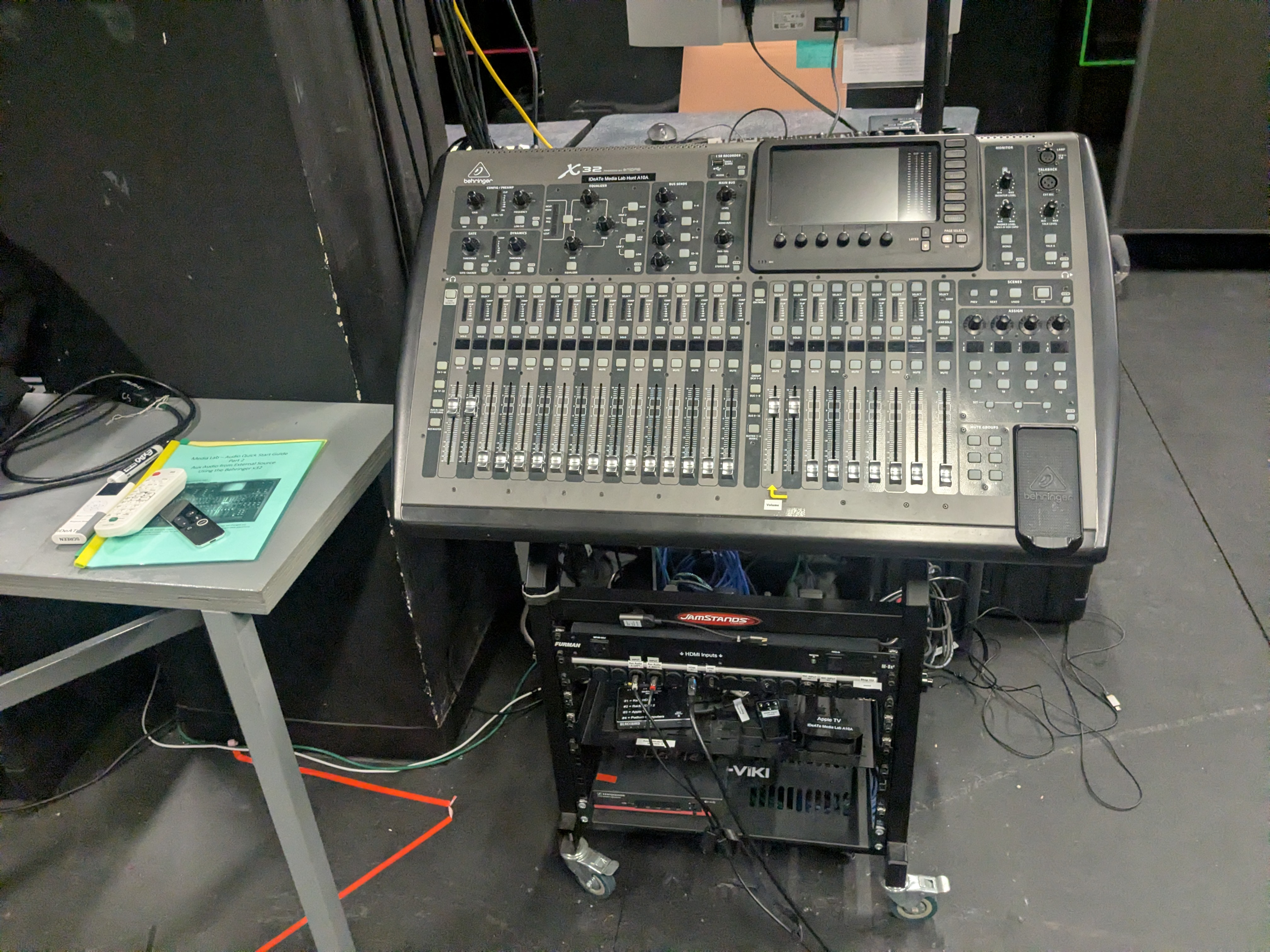
The IDeATe Media Lab can be found in room A10A in the basement of Hunt Library. The Media Lab is a black box studio with lighting and sound equipment such as a Behringer x32 digital mixer, a surround-sound system of eight speakers, and a computer controlled DMX multi-color, LED lighting array in the ceiling. The entire back wall has a projection screen surface overlaid on it.“Anything that needs controlled lighting, sound, special space configurations, or movement based activities happens in this room,” said Cody Soska, the Technical Specialist for IDeATe. “The Media Lab can be adopted for a number of AV purposes by sound designers, creative audio artists, dancers, animators, or videographers — the artistic vision of the space is to support anyone trying to do work with a combination of form and sound.”

Many IDeATe classes are held in the media lab, such as:

“I’ve taken Exploded Ensemble in this room every semester I’ve been here, so I know everything in this room and how to use it,” said Allen Zhu, a senior studying electronic music. “The eight speakers in here create a very unique listening environment. The only place that comes close to it is Fred Rogers’ old studio in WQED, and this place is more accessible to students.”
Zhu added that although it can take some technical expertise to use the room to its full capabilities, it’s worth putting effort into — and if you’re struggling, his advice is to read the manual for the equipment.
Johannes DeYoung, Associate Professor of Art, said that the room is useful for film screenings, or staging theatrical events that can take advantage of the speakers and lighting system. “Although the room is most often used for electronic music, it’s been fantastic when I can use it to teach animation classes,” he said. “It’s well-equipped with theatrical lighting and it has a variety of instruments in a grid that you can suspend screens for installation based work or projection mapping. Everything is also on wheels, so we can reconfigure the space depending on what the class needs!”
Students that have taken a class in the Media Lab can reserve it to work on their own projects by emailing help@ideate.cmu.edu, and they can find open times by using IDeATe’s online reservation system. The rules for using the space include no food or beverages allowed in the Media Lab, and shutting down equipment if you are the last person in the lab to prevent damage.